Purlisse Beauty Blue Lotus Essential Daily Moisturizer Spf 30
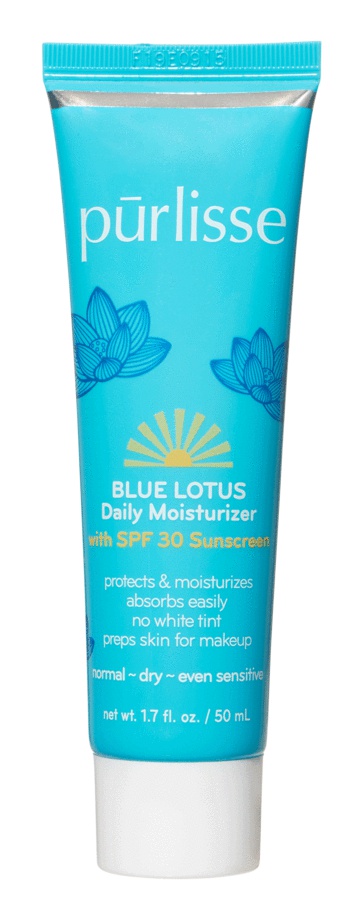
Blue Lotus Daily Moisturizer With Spf thirty Sunscreen
Moisturizing Confront Lotion with SPF 30. For Dry, Normal and Sensitive Skin.
Uploaded by: ehauck925 on
Ingredients overview
H2o (Aqua), Glycerin, Cetearyl Alcohol, Dimethicone, Cyclopentasiloxane, Tocopheryl Acetate, Hydrolyzed Lupine Protein Octenylsuccinate, Aphanizomenon Flos-Aquae Excerpt, Hydrolyzed Soy Protein, Camellia Sinensis Leaf Extract, Nymphaea Caerulea Flower Extract, Sodium Hyaluronate, Dipotassium Glycyrrhizate, Dicetyl Phosphate, Ceteth-10 Phosphate, Aminomethyl Propanol, Carbomer, Disodium EDTA, Chlorphenesin, Caprylyl Glycol, Phenoxyethanol, Fragrance
Highlights
Key Ingredients
Other Ingredients
Skim through
| Ingredient name | what-information technology-does | irr., com. | ID-Rating |
|---|---|---|---|
| Water (Aqua) | solvent | ||
| Glycerin | skin-identical ingredient, moisturizer/humectant | 0, 0 | superstar |
| Cetearyl Booze | emollient, viscosity controlling, emulsifying, surfactant/cleansing | i, ii | |
| Dimethicone | emollient | 0, 1 | |
| Cyclopentasiloxane | emollient, solvent | ||
| Tocopheryl Acetate | antioxidant | 0, 0 | |
| Hydrolyzed Lupine Protein Octenylsuccinate | |||
| Aphanizomenon Flos-Aquae Extract | moisturizer/humectant | goodie | |
| Hydrolyzed Soy Protein | moisturizer/humectant | ||
| Camellia Sinensis Leafage Excerpt | antioxidant, soothing | goodie | |
| Nymphaea Caerulea Flower Excerpt | |||
| Sodium Hyaluronate | pare-identical ingredient, moisturizer/humectant | 0, 0 | goodie |
| Dipotassium Glycyrrhizate | soothing, moisturizer/humectant | goodie | |
| Dicetyl Phosphate | emulsifying, surfactant/cleansing | ||
| Ceteth-10 Phosphate | surfactant/cleansing | ||
| Aminomethyl Propanol | buffering | ||
| Carbomer | viscosity controlling | 0, 1 | |
| Disodium EDTA | chelating | ||
| Chlorphenesin | preservative, antimicrobial/antibacterial | ||
| Caprylyl Glycol | moisturizer/humectant, emollient | ||
| Phenoxyethanol | preservative | ||
| Fragrance | perfuming | icky |
Purlisse Bluish Lotus Daily Moisturizer With Spf 30 Sunscreen
Ingredients explainedAlso-chosen: Aqua | What-it-does: solvent
Adept old water, aka H2O. The nearly common skincare ingredient of all. You can usually find it right in the very first spot of the ingredient listing, significant it'due south the biggest affair out of all the stuff that makes up the product.
It's mainly a solvent for ingredients that do non similar to dissolve in oils but rather in water.
Once inside the peel, it hydrates, but not from the exterior - putting pure h2o on the skin (hi long baths!) is drying.
One more thing: the h2o used in cosmetics is purified and deionized (information technology means that about all of the mineral ions within it is removed). Like this, the products tin stay more than stable over time.
- A natural moisturizer that'south also in our pare
- A super common, safe, effective and cheap molecule used for more than than 50 years
- Not only a simple moisturizer but knows much more: keeps the skin lipids between our skin cells in a healthy (liquid crystal) land, protects against irritation, helps to restore barrier
- Constructive from as low as 3% with fifty-fifty more than benefits at higher concentrations up to twenty-twoscore% (around x% is a adept usability-effectiveness sweet spot)
- High-glycerin moisturizers are awesome for treating severely dry skin
Read all the geeky details about Glycerin here >>
An extremely mutual multitasker ingredient that gives your pare a squeamish soft feel (emollient) and gives body to creams and lotions. It as well helps to stabilize oil-h2o mixes (emulsions), though information technology does non office as an emulsifier in itself. Its typical utilize level in nigh cream type formulas is 2-3%.
It's a and so-called fatty alcohol, a mix of cetyl and stearyl alcohol, other two emollient fatty alcohols. Though chemically speaking, it is alcohol (equally in, information technology has an -OH grouping in its molecule), its properties are totally different from the properties of low molecular weight or drying alcohols such as denat. booze. Fatty alcohols accept a long oil-soluble (and thus emollient) tail role that makes them absolutely non-drying and not-irritating and are totally ok for the skin.
What-it-does: emollient | Irritancy: 0 | Comedogenicity: 1
Probably themost common silicone of all. It is a polymer (created from repeating subunits) molecule and has unlike molecular weight and thus different viscosity versions from water-light to thick liquid.
As for skincare, it makes the skin silky smooth, creates a subtle gloss and forms a protective barrier (aka occlusive). As well, works well to fill in fine lines and wrinkles and give skin a plump look (of course that is merely temporary, simply still, it's prissy). There are too scar treatment gels out there using dimethicone every bit their base ingredient. It helps to soften scars and increase their elasticity.
As for hair care, it is a non-volatile silicone meaning that information technology stays on the hair rather than evaporates from it andsmoothes the pilus like no other thing. Depending on your hair type, it tin can bea scrap hard to wash out and might cause some build-up (btw, this is not true to all silicones, simply the not-volatile types).
A super normally used v unit of measurement long, cyclic structuredsilicone that is h2o-thin and does non stay on the skin but evaporates from it (chosen volatile silicone). Similar to other silicones, information technology gives peel and hair a silky, smooth feel.
It's often combined with the not-volatile (i.due east. stays on the skin) dimethicone as the two together course a water-resistant, breathable protective barrier on the skin without a negative tacky feel.
Also-called: Vitamin E Acetate | What-it-does: antioxidant | Irritancy: 0 | Comedogenicity: 0
It's the most commonly used version of pure vitamin E in cosmetics. You tin read all about the pure form here. This one is the so-called esterified version.
According to famous dermatologist, Leslie Baumann while tocopheryl acetate is more stable and has a longer shelf life, it's as well more poorly captivated past the skin and may non have the same crawly photoprotective effects as pure Vit E.
 We don't accept description for this ingredient yet.
The extract coming from arare, blue-green algae that's touted to accept retinoid-similar effects but without the side effect. If you exercise not know what retinoids are, you lot are seriously missing out, please click here and catch up on the topic.
To be more specific almost the "retinoid-similar effects", the manufacturer institute that Lanablue (the trade name of this algae) affects gene expression (a fancy fashion of maxim how an ingredient might influence how a skin jail cell produces dissimilar things such equally proteins) and regulates epidermal differentiation (how skin cells at the bottom of the top layer of our skin replicate) like to expert-old retinol. Yet, that is only in-vitro (made in test-tubes) data, that may or may non happen on existent human skin.
Every bit far every bit clinical data goes, the manufacturer did a 21 days study with xl volunteers and found that 3% Lanablue showed a "clear reduction of the skin microrelief", or to say information technology in another fashion, information technology made the skin smoother. Based on the data we have seen, nosotros think that "retinoid-like effects" claim for this algae is an exaggeration. If y'all are into retinol alternatives, Bakuchiol is a more promising molecule to bank check out.
We don't have description for this ingredient yet.
- Green tea is ane of the most researched natural ingredients
- The agile parts are chosen polyphenols, or more precisely catechins (EGCG being the nearly arable and most active catechin)
- There can be huge quality differences between green tea extracts. The good ones incorporate l-xc% catechins (and often make the production brownish and give it a distinctive smell)
- Light-green tea is proven to exist a great antioxidant, UV protectant, anti-inflammatory, anticarcinogenic and antimicrobial
- Considering of these crawly properties green tea is a great pick for anti-crumbling and also for skin diseases including rosacea, acne and atopic dermatitis
Read all the geeky details almost Camellia Sinensis Leaf Extract here >>
Nosotros don't have description for this ingredient even so.
Information technology's the - sodium class - cousin of the famous NMF, hyaluronic acrid (HA). If HA does non tell you lot anything nosotros have a super detailed, geeky caption about it here. The TL; DR version of HA is that information technology's a huge polymer (big molecule from repeated subunits) found in the peel that acts as a sponge helping the skin to hold onto water, beingness plump and elastic. HA is famous for its crazy water holding capacity as information technology tin bind upward to 1000 times its ain weight in water.
As far as skincare goes, sodium hyaluronate and hyaluronic acid are pretty much the same and the two names are used interchangeably. Equally cosmetic chemist kindofstephen writes on reddit "sodium hyaluronate disassociates into hyaluronic acid molecule and a sodium atom in solution".
In spite of this, if you lot search for "hyaluronic acrid vs sodium hyaluronate" you will find on multiple places that sodium hyaluronate is smaller and can penetrate the pare better. Chemically, this is definitely not true, as the two forms are most the same, both are polymers and the subunits tin exist repeated in both forms as much every bit you like. (Nosotros also checked Prospector for sodium hyaluronate versions actually used in cosmetic products and found that the near mutual molecular weight was 1.5-i.8 meg Da that absolutely counts as high molecular weight).
What seems to be a true difference, though, is that the salt class is more stable, easier to formulate and cheaper so it pops up more than often on the ingredient lists.
If you lot wanna go a existent HA-and-the-skin skilful you can read mode more about the topic at hyaluronic acrid (including penetration-questions, differences betwixt loftier and low molecular weight versions and a bunch of references to scientific literature).
The salt form of ane of the master anti-inflammatory ingredients in the licorice plant, monoammonium glycyrrhizinate. It'south a yellowish powder with a nice sweet odour.
It's used mainly for its soothing and anti-inflammatory properties, simply according to manufacturer info, it'southward besides sebum regulating and so it's a perfect ingredient for problem skin products.
Nosotros don't have description for this ingredient yet.
Nosotros don't accept clarification for this ingredient still.
An element of group i (high pH, aka basic) fabric that is used to set the pH of the cosmetic formula to the correct value.
A big molecule created from repeated subunits (a polymer of acrylic acid) that magically converts a liquid into a dainty gel formula. It usually has to exist neutralized with a base of operations (such as sodium hydroxide) for the thickening to occur and it creates glutinous, articulate gels that also feel prissy and non-tacky on the peel. No wonder, it is a very pop and common ingredient. Typically used at 1% or less in most formulations.
Super common little helper ingredient thathelps products to remain nice and stable for a longer time. It does so by neutralizing the metal ions in the formula (that commonly get into there from water) that would otherwise cause some not so nice changes.
It is typically used in tiny amounts, effectually 0.1% or less.
A little helper ingredient that works as a preservative. Information technology works against bacteria and some species of fungi and yeast. It's oft combined with Information technology-preservative, phenoxyethanol.
It's a handy multi-tasking ingredient that gives the skin a squeamish, soft feel. At the same time, it likewise boosts the effectiveness of other preservatives, such as the nowadays super unremarkably used phenoxyethanol.
The alloy of these two (caprylyl glycol + phenoxyethanol) is called Optiphen, which not only helps to keep your cosmetics gratis from nasty things for a long time but also gives a good feel to the finished product. It'south a popular duo.
It's pretty much the current Information technology-preservative. Information technology'south safe and gentle, merely even more chiefly, it'south not a feared-by-everyone-mostly-without-scientific-reason paraben.
It's not something new: it was introduced around 1950 and today it tin be used upwardly to 1% worldwide. It can be found in nature - in green tea - just the version used in cosmetics is constructed.
Other than having a skilful condom profile and being quite gentle to the skin it has some other advantages too. It can exist used in many types of formulations as it has dandy thermal stability (can exist heated up to 85°C) and works on a wide range of pH levels (ph three-10).
It'southward often used together with ethylhexylglycerin as information technology nicely improves the preservative activity of phenoxyethanol.
As well-called: Fragrance, Parfum;Parfum/Fragrance | What-it-does: perfuming
Exactly what it sounds: nice smelling stuff put into cosmetic products so that the end product besides smells nice. Fragrance in the US and parfum in the EU is a generic term on the ingredient listing that is fabricated up of 30 to fifty chemicals on average (just it tin can take equally much as 200 components!).
If you are someone who likes to know what you put on your face then fragrance is not your best friend - there'south no way to know what's actually in it.
Likewise, if your skin is sensitive, fragrance is again not your best friend. It's the number one cause of contact allergy to cosmetics. Information technology's definitely a smart affair to avoid with sensitive skin (and fragrance of any type - natural is just as allergic as synthetic, if non worse!).
Yous may too want to take a look at...
Normal (well kind of - information technology's purified and deionized) h2o. Usually the primary solvent in cosmetic products. [more] A real oldie simply a goodie. Great natural moisturizer and peel-identical ingredient that plays an of import role in pare hydration and general peel health. [more than] A super common multitasker ingredient that gives your pare a nice soft experience (emollient) and gives body to creams. [more] A very common silicone that gives both skin and pilus a silky smooth experience. It also forms a protective barrier on the skin and fills in fine lines. Also used for scar treatment. [more] Information technology's a super commonly used h2o-thin volatile silicone that gives skin and hair a silky, shine feel. [more] A form of vitamin E that works as an antioxidant. Compared to the pure form it'south more stable, has longer shelf life, just it'south as well more than poorly captivated by the pare. [more] It's the salt form of famous humectant and natural moisturizing factor, hyaluronic acid. It can bind huge amounts of water and it'southward pretty much the current Information technology-moisturizer. [more] The common salt form of one of the chief anti-inflammatory ingredients in the licorice plant, monoammonium glycyrrhizinate. It's a xanthous pulverisation with a overnice sugariness smell. It's used mainly for its soothing and anti-inflammatory properties, but co-ordinate to manufacturer info, it'due south besides sebum regulating so it' [more] An alkaline (high pH, aka basic) material that is used to gear up the pH of the cosmetic formula to the right value. [more than] A handy white pulverisation that magically converts a liquid into a prissy gel formula. [more] Super common little helper ingredient that helps products to remain nice and stable for a longer time. It does so by neutralizing the metal ions in the formula (that normally get into at that place from water) that would otherwise cause some non so nice changes. [more] A little helper ingredient that works as a preservative. It works against bacteria and some species of fungi and yeast. [more] A handy multi-tasking ingredient that gives the pare a nice, soft feel and too boosts the effectiveness of other preservatives. [more than] Pretty much the electric current IT-preservative. Information technology's safety and gentle, and tin can be used up to 1% worldwide. [more] The generic term for nice smelling stuff put into corrective products so that the end production as well smells nice. It is fabricated upwards of 30 to 50 chemicals on average. [more]
Source: https://incidecoder.com/products/purlisse-blue-lotus-daily-moisturizer-with-spf-30-sunscreen
Belum ada Komentar untuk "Purlisse Beauty Blue Lotus Essential Daily Moisturizer Spf 30"
Posting Komentar