Mannerism Is a Type of Art That Followed the Renassiance and Is Described as
This mail service may contain affiliate links. If y'all make a buy, My Modern Met may earn an chapter commission. Please read our disclosure for more info.
During the Renaissance, Italian artists found inspiration in the ideal forms and harmonious compositions of classical artifact. While this reinterpretation of ancient models is famously evident in the works of Loftier Renaissance artists like Michelangelo and Leonardo da Vinci, it also manifested every bit Mannerism, a mode that emerged toward the stop of the motility.
Mannerist artists took the principles established during the Renaissance to new extremes, culminating in an artful that put a stylized twist on classicism. Here, nosotros take a wait at this lesser-known manner, exploring its history and presenting the characteristics that ascertain information technology.
What is Mannerism?
Mannerism is a style that emerged in 1530 and lasted until the end of the century. Information technology is named subsequently maniera , an Italian term for "fashion" or "fashion," and refers to a stylized, exaggerated approach to painting and sculpture.
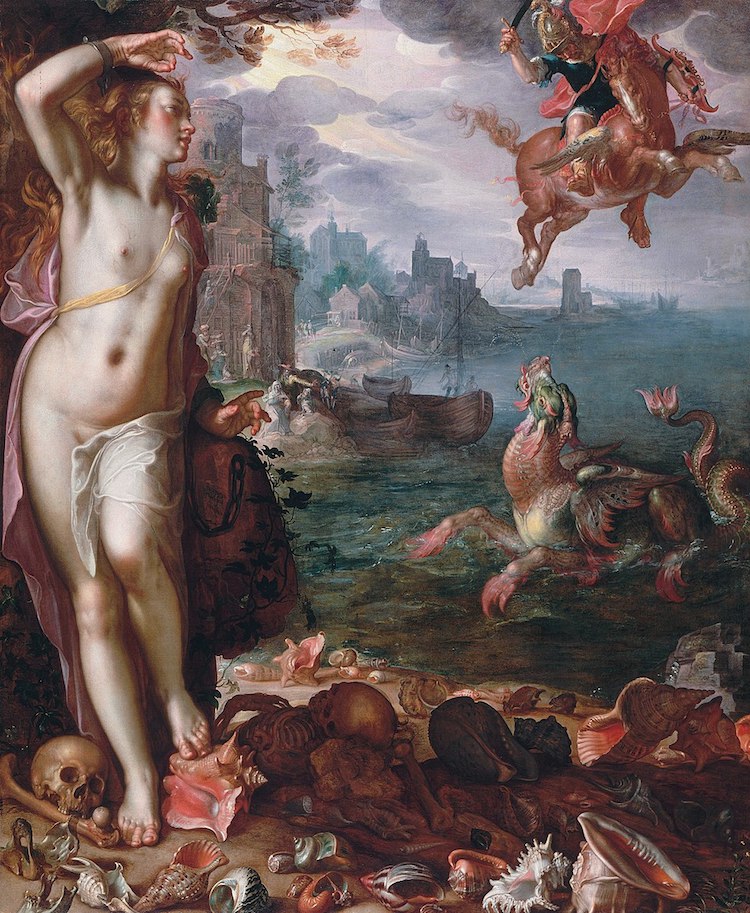
Joachim Wtewael, "Persus and Andromeda," 1611 (Photo via Wikimedia Commons Public Domain)
Also known as the Belatedly Renaissance, Mannerism is regarded equally a bridge betwixt the High Renaissance and the Baroque period, which adopted the subset's ornate aesthetic and adapted information technology equally extravagance.
History
In the tardily 15th century, artists in Florence began to forego the ethereal iconography of the Dark Ages in favor of classicism. This aesthetic arroyo lasted until the 17th century and culminated in three subsets: the Early Renaissance, the High Renaissance, and the Belatedly Renaissance.
During the Early Renaissance, artists began looking to antiquity for inspiration. This newfound involvement would then inform theHigh Renaissance, a genre characterized past naturalistic figures and a mathematically precise use of perspective. The High Renaissance lasted from 1490 until the 1530s, when the Late Renaissance, or Mannerism, emerged.
While Mannerist artists were interested in the perfectionism portrayed past High Renaissance artists, they did not seek to replicate it. Instead, they exaggerated Renaissance principles, resulting in piece of work that favors self-expressionism over the pursuit of idealism. "Rather than adopting the harmonious ideals associated with Raphael and Michelangelo," the Tate explains, "[Mannerists] went a pace further to create highly artificial compositions which showed off their techniques and skills in manipulating compositional elements to create a sense of sophisticated elegance."
Characteristics
Exaggerated Figures
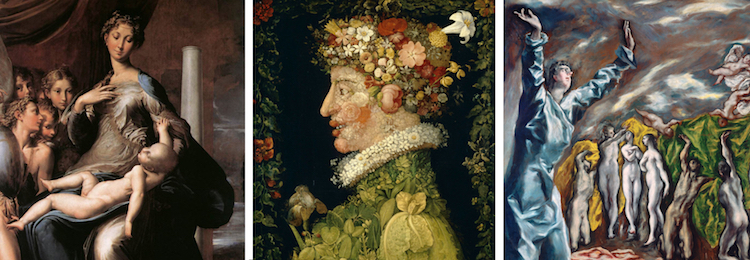
A primary way that Mannerist artists took High Renaissance techniques "a step further" is throughexaggeration. Pioneered by Parmigianino, an Italian artist, Mannerists rejected realistic proportions and instead rendered figures with impossibly elongated limbs and oddly positioned bodies. These stretched and twisted forms were likely employed to suggest movement and raise drama.
Co-ordinate to Giorgio Vasari, a prominent Italian painter, builder, historian, and writer, Parmigianino inadvertently adopted this unusual aesthetic while painting his own likeness. "In guild to investigate the subtleties of art," Vasari says of Parmigianino in his famous art history volume, The Lives of the Artists, "he set up himself one day to make his own portrait, looking at himself in a convex hairdresser's mirror. And in doing this, perceiving the bizarre effects produced by the roundness of the mirror, which twists the beams of a ceiling into foreign curves, and makes the doors and other parts of buildings recede in an extraordinary style, the idea came to him to amuse himself past counterfeiting everything."
Elaborate Decoration
Lavish adornment is another way Mannerists pushed Renaissance sensibilities to their limits. While High Renaissance figures did not typically incorporate patterns into their work, Early on Renaissance artists like Sandro Botticelli did. Inspired by millefleur (from the French mille-fleurs, or "grand flowers")tapestries of the Middle Ages, Botticelli incorporated floral designs into his large-scale mythological paintings similar Primavera.
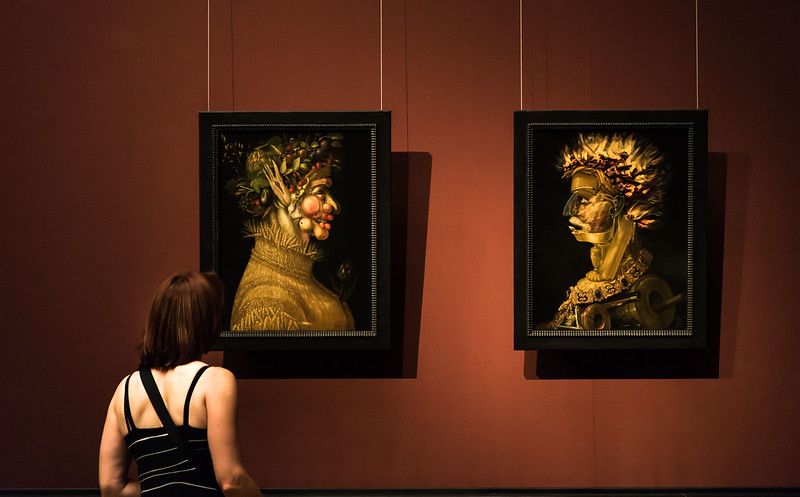
Mannerist artists, in plough, revisited this interest in elaborate ornament, covering both canvases and sculptures in an overwhelming abundance of decorative elements. One artist who took this concept to astonishing new levels is Giuseppe Arcimboldo, a painter who crafted peculiar portraits of people made out of vegetation, animals, and found objects.
Artificial Color
Finally, Mannerists abased the naturalistic colors used by High Renaissance painters and instead employed bogus—and often garish—tones. These unrealistic hues are especially apparent in the work of Jacopo da Pontormo, an Italian artist whose saturated palette took the rich colors of the Renaissance to new heights.
This arroyo to color is also famously associated with El Greco, a Castilian painter who adopted the Mannerist style when he moved to Rome. Like other Mannerists, El Greco looked to earlier artists without attempting to reproduce their work. "Y'all must written report the Masters," he said, "but guard the original style that beats inside your soul and put to sword those who would try to steal it."
Legacy
Though a subset of the Renaissance—arguably art history's virtually impactful art movement—Mannerism is not held in the aforementioned esteem as the Golden Age's before piece of work. Notwithstanding, its distinctive aesthetic continues to enchant those who are aware of it, making it one of art history's most fascinating subconscious gems.
Related Articles:
Exploring the Major Contributions of the Bottom-Known 'Northern Renaissance'
How Artists Take Kept Notwithstanding Life Painting Alive Over Thousands of Years
The History of Cupid in Art: How the God of Honey Has Inspired Artists for Centuries
How Museums Evolved Over Time From Private Collections to Modern Institutions
Source: https://mymodernmet.com/what-is-mannerism/
Belum ada Komentar untuk "Mannerism Is a Type of Art That Followed the Renassiance and Is Described as"
Posting Komentar